Its no secret that social media really is changing everything.Clay Shirky on TED.com talks about the advances of media starting from: few-to-few, one-to-many, and finally into today’s many-to-many.
Mr. Shirkey says of our technological innovations that they “don’t get socially interesting until they get technologically boring”. Rather than the newest most up-to-date gadget on the market, it is that which becomes ubiquitous that fuels this revolution; the “largest increase in expressive capability in human history”.
This talk was given in less than a month ago and the events taking place in Iran (#IranElection) are only proving and expanding this theory.The many-to-many media (Twitter, SMS, and cellular technology) is besting the government’s efforts for censorship - while not only alerting the outside world but still functioning to organize, inform, and give voice to the people within Iran.
Will social media be the battleground for next “War on-”; the "war on networking"?
An early submission by A.M. titled On the Nature of the Universe & the 'Creator' deals with much the same subject matter; trying to delineate a spirituality compatible with science. My essay on Monistic Pluralism attempts to describe the presence of a unified singularity with legitimate individuals, minds or perceptions that function (though often ignorant of their connection) within that singularity. The notion of Interconnectivity of all things brings to my mind the provocative allegory of Indra's Net. I have been briefly introduced to Kabbalaistic thought which views the totality of creation as a single system [We Must Become a Part of Nature's System, We Are One Whole], quite similar to the philosophic approach I took to our integration with nature in the article As Humans... For me, the composite of all of this is currently crystallizing around some of George Santayana's thought as outlined in Santayana's Spirituality and investigated in more depth in Liberating the Spirit.
The following is an essay I wrote for a philosophy class:
Liberating the Spirit
George Santayana, a well known skeptical thinker and self-proclaimed materialist, created an in depth ontology which includes the realm of Spirit.This realm of spirit does not include the pseudo-religious way we commonly use the word to signify supernatural creators or death-surviving selves.Instead, “spirit is an awareness natural to animals, revealing the world and themselves in it (1).”This spirit may go by many other names including “consciousness, attention, feeling, thought, or any word that marks the total inner difference between being awake or asleep, alive or dead (1).”After recognizing the spirit we may move on to address the potential of liberation or salvation of the spirit; prospects which are so naturally ingrained in humans as evidenced by the rise of religions as well as the universal questions surrounding the meaning of life.
In order to understand Santayana’s realm of spirit we must first understand consciousness - which is a collection of units of momentary cognitive awareness or intuition, directing its attention at the essences which give form to objects.More basic than the spirit is the psyche – “the organic order and potentiality in a living body” and the animal force concerned with its own survival and other animal needs (2).The psyche is a more primitive form of intelligence, but is essential as a host for the creation and survival of the spirit.As “spirit is a product of the psyche” the two naturally share many affinities (2).However, the crucial difference remains: psyche is the pattern of self-maintenance and reproduction which holds its organism most valuable whereas spirit does not have persistence or potential (1) but is rather the transcendental “unattached spectator of all time and existence and the contemplator of every possibility (4).”
The Spirit wanders the world, always centered in the ‘now’ and always at the ‘here,’ observing the ways of nature and witnessing “the cosmic dance” that nature performs (1).Spirit may take on many interests.It may be “philosophical, absorbed in curiosity and wonder, impressed by the size, force, complexity, and harmony of the universe” or it may simply be a “station from which to survey the world (2).”
However, the spirit often has a hard time in realizing itself.It faces many hardships from its animal body and psyche that mitigate its transcendence.Santayana suggests that the spirit suffers torment out of sympathy for its poor lost psyche being put through the hardships of earthly life (1).The spirit wishes to see through this confusion to a vista of clarity and understanding.
Attachment is a great source of pain for both psyche and spirit.It is ignorant for a spirit to “attach itself absolutely to anything relative” – even its own life (2).This may be impossible for the psyche to accept graciously, but “the assurance that truth is eternal and that life and beauty may be perpetually renewed in other shapes” can comfort the spirit (2).The miracle of life is granted with a guarantee of death.In fact, in this cyclical pattern “life is a perpetual resurrection; and spirit too is continually being born again (2).”Spirit can rest assured of “the same rational light breaking out anew in some fresh creature (2).”
Santayana suggests we view our particular existences not as intentional occurrences planned by supernatural creators, but rather as accidents.This view, while being more scientific, also makes our happening more rare and more interesting.But we still seek salvation or liberation from the toils and troubles and pains our bodies and psyches must endure.Santayana claims that the spirit offers salvation “by shifting the centre of appreciation from human psyche to the divine spirit (2).”This salvation goes by many different names including Brahma, Nirvana, and accepting the Spirit of Christ; although it is often interpreted to include a false supernatural aspect.Instead of this external non-natural force, it is man himself “a human person assuming and adopting a divine nature (2).”
Humans may lapse in and out of touch with their spirituality, or they may choose to remain ‘enlightened’ through devotion.“Absorption in pure intuition, even if temporary, constitutes the spiritual life (3).”Necessarily, this life is “free of values and empty of striving,” because the enlightened knows not to attach to relative things (3).To live this spiritual life one must replace ideas, emotions, fears, and attachments with spontaneous, disinterested, pure intuition and thereby “detaching us from each thing with humility and humour, and attaching us to all things with justice charity and pure joy” enabling the enjoyment of truth and essence (2).
I have relayed Santayana’s view through this intellectual medium, but the actual attainment and realization of spirit would be better helped along by a poet, a painter, a songbird, or a sunrise.
“Awaken attention, intensify it, purify it into white flame, and the actual and unsubstantial object of intuition will stand before you in all its living immediacy and innocent nakedness (3).”
When that “supreme moment liberates us” we accept it without thinking or judging it and “feel withdrawn into an inner citadel of insight and exaltation (2).”
Works Cited
1)The Nature of Spirit from Realms of Being (New York: Charles Scribner’s Sons, 1942 [1937]), pp. 555-572
2)Liberation from Realms of Being (New York: Charles Scribner’s Sons, 1942 [1937]), pp. 736-767
3)Essence from Realms of Being (New York: Charles Scribner’s Sons, 1942 [1937]), pp. 1-25
4)Stuhr, John J. (Ed.). (2000). Pragmatism and Classical American Philosophy. New York, NY: OxfordUniversity Press.
The following is an essay I wrote for a philosophy class; what do you think? leave some comments.
Monistic Pluralism & Pole Dichotomies
The first of the seven characteristics of classical American philosophical thought is the ‘rejection of modern philosophy’ (Stuhr, 3).The reason for rejecting the prior pattern of thought was that it was “fundamentally dualistic” and attempted to answer philosophical questions in terms of dichotomies.These dichotomies are not actual categories that exist separate of the object we are describing but rather descriptions that we create to contrast one to another.We say ‘either/or’ in attempts to understand that thing’s essence; at least in terms of its relationships to idealized signs (Stuhr, 66).The pattern that emerges from this thought process is one of discrimination, separation, exclusion, and isolation where parts no longer constitute a whole but have an individuality that drives them apart.Philip Kapleau writes in the introduction to Zen Keys:
“We are deceived by our limited five senses and discriminating intellect (the sixth sense in Buddhism) which conveys to us a picture of a dualistic world of self-and-other, of things separated and isolated ...This picture is untrue because it barely scratches the surface. ... For if we could see beyond the ever-changing forms into the underlying reality, we would realize that in essence there is nothing but harmony and unity” (Hahn, 8).
This dualistic view of the world cannot give us a complete understanding because the mind does not function like a box with separate containers but more like a stream flowing with multidirectional currents (Stuhr, 149).
In opposition to this dualistic perspective, the classical American philosophy offers two seemingly opposite yet interrelated options: a monistic view and pluralistic view.The monistic belief is that the true nature of the universe is as a singularity; one wholeness that we are too limited to understand so we cling onto parts.Pluralism holds that because our experiences are unique to us as individuals that they are all equally valuable and equally real.As William James writes, “For pluralism, all that we are required to admit as the constitution of reality is what we ourselves find empirically realized in every minimum of finite life” (Stuhr, 4). It is entirely possible for individuals to have pluralistically valid individual experiences while at the same time existing as part of an integrated whole.
Jill Bolte Taylor, a neuro-anatomist explains how both dualistic and monistic thought are embedded within us.She presents a model where the left and right hemispheres of the brain have seemingly different personalities.While this lateralization of personalities within brain might be debated, her description of the left hemisphere fits with what William James calls The Tough-Minded while the right hemisphere is Tender-Minded.It is the left hemisphere, says Taylor, that is responsible for the ego and hence the duality of ‘I’ verses the ‘other’ while the right hemisphere has a tendency for a monistic view of being one with everything.Interestingly enough, she describes the ‘I’ to be solely concerned with past and future while the ‘we’ is solely in the now moment (Taylor).The ability to remember the past as a source of experience and foresee the future has very practical applications in terms of human survival. Unfortunately, this ability also leads to anxiety as we worry over possible outcomes.The ability to be ‘in the now’ can lead to internal peace and well-being.As James would agree, “we are actually multiple selves” functioning as one mutually interdependent being with “neurological unity” (Stuhr, 142).
Hegel is quoted as saying, “The aim of knowledge is to divest the objective world of its strangeness and to make us more at home in it” (Stuhr, 153).But this raises the question of how do we become more comfortable in a world where increasing knowledge leads to greater separation and distinction and we become stranger and farther away from the world we live in.To use an analogy, it is as if we began to take a clock apart to see how it works.We began studying and cataloguing all the parts and even figuring out how they relate to one another, but we became so engrossed in our work that by time we put the clock back together we forgot what its purpose was.Hegel speaks about this process:
“[the object is] a totality in itself, while at the same time (as this identity is only the implicit identity of its dynamic elements) it is equally indifferent to its immediate unity. It thus breaks up into distinct parts, each of which is itself the totality. Hence the object is the absolute contradiction between a complete independence of the multiplicity, and the equally complete non-independence of the different pieces” (Hegel).
I think this idea was at least in part represented when Charles Sanders Peirce critiqued the Cartesian method of doubt- for to be absolutely certain of everything we know and feel would divest the universe of its purpose and meaning (Stuhr, 45).
The act of drawing boxes within our minds to categorize information can be a useful way to establish facts, however if we are not careful we may forget that we have the option to view the world as a unified whole.It is quite possibly because of an imbalance in the dichotomic equilibrium with the human character that we are facing the world crises we see today (although it could possibly also be accredited as to why we are around today).The aim is for the observing mind to see the universe as a unified whole while simultaneously being able to make the distinctions that enable survival.Such a method combining monism with pluralism may lead to the ability for a richer understanding.
Works Cited
Hahn, Thich Naht. Zen Keys. Garden CityNY: Doubleday, 2005.
Hegel, Georg. "Hegel, The Notion, Part B. The Object." Encyclopedia of Philosophical Sciences. 13 Mar 2009 .
Stuhr, John J. (Ed.). (2000). Pragmatism and Classical American Philosophy. New York, NY: OxfordUniversity Press.
Taylor, Jill Bolte. "My Stroke of Insight." TED 229Mar 2008 13 Mar 2009 .
Searching today’s Google Trends USA (around 11:45AM) I noticed that 5 of the top 10 most searched words are related to a NASCAR wreck that took place in Talladega.
Of only slightly less importance is the outbreak of swine flu with flu and CDC related searches taking 3 of the top 10 spots. Ranking in at number 2 overall is “morris code” – a very popular reference to “morse code” most likely motivated by Google’s celebration of Samuel Morse’s birthday. Other popular topics include football, the fate of our auto companies, cell phone plans, free chicken, and of course celebrities - with “britney spears tampon” being the 32nd most interesting thing happening in the USA today.
I sincerely hope that these search trends are not indicative of what people truly care about (with some exception for the swine flu because although we should not fear it, the sharing of information is playing a vital role in preventing/containing a pandemic).
An interesting side note: this article titles “Save the Earth: Ban NASCAR” highlights some of the eco-unfreindly attributes of America’s most popular sport.
The concept behind Earthships is to build environmentally sustainable and self-sufficient housing. Earthships recycle materials such as old tires, aluminum cans, and plastic bottles as building materials. Reusing materials like this saves on the energy that is required to recycle. These tires are filled with earth or clay serve as great insulators – naturally maintaining a comfortable living temperature. Partially burying the building, along with orienting it toward or away from the direction of light can maximize energy efficiency.
In addition, Earthships are often outfitted with solar panels or wind turbines for energy, and rainwater collection systems for much of the water needed. Water is recycled through various stages using plants to absorb and filter the water.
By utilizing modern advances in technology and our understanding of systems and design, we may create a way to live a better more integrated and sustainable lifestyle.
Not all 'green' homes need to be made in the Earthship design. Here is an example of another home with low
In honor of Earth Day I am posting information regarding environmental sustainability. First I will mention that every day should be Earth Day. We have a responsibility to take care of ourselves through taking care of our one and only beautiful blue and green planet. Attending the Fairleigh Dickinson University Green Day celebration just the other day opened my horizons. Most notably to the concept of permaculture, which is an approach to designing our lifestyles to be in harmony with nature – most effectively done by mimicking some of the natural systems that already exist. Permaculture and Agroforestry are both forms of agro-ecological design theory.
For anyone in the New Jersey area particularly interested in business, Green Ventures, and sustainable business practices, FDU is offering a few seminars on these topics:
I have been reading some of George Santayana’s philosophical thoughts. I find his view of spirituality of particular interest.Without going into much detail here, I will briefly lay the framework of Santayana’s thought so as to provide context.
Santayana defines four realms; the Realms of: Essence, Matter, Truth, & Spirit.Essence is the totality of all (infinite) forms each of which is perfectly self-identical and eternal. Essences are not physical (although physicality is an essence) and are independent of time and space.
Occasionally an essence is wrenched into momentary existence out of the vague infinity. Traditionally this force is called the creative power of “God,” but Santayana argues otherwise. Instead he calls this the unintelligible force of Matter which has no ultimate reason. Existence is “an insane emphasis” and the patterns and habits of existence do not remove its arbitrariness.
The realm of Truth contains all objective facts. Anything that ever had/has/will have Essence and Matter – the fact that an essence did, does, will exist in the physical world – is Truth. Such objective truths are merely humble facts and serve only as an ideal for which we may aim.
To understand the realm of spirituality we must first understand consciousness - which is a collection of units of momentary cognitive awareness (intuition) directed at an object. This object is an essence.Because of our psyches (the human organism behind the consciousness) we cannot enjoy these aesthetic essences at face value.To truly enjoy the objects of our consciousness we must be free of convictions and belief, thus having pure intuition. In this way the spiritual life frees us from the world of organically based values.
The spirit is a novel form of being that emerges from the cognitive awareness of consciousness. The perfection of this consciousness “is to be the unattached spectator of all time and existence and the contemplator of every possibility. Such transcendence in thought of the physical is what we normally mean by spirituality...Absorption in pure intuition, even if temporary, constitutes the spiritual life. This spiritual life is thus free of values and empty of striving.”
This idea seems to me to be reminiscent of the Hindi concept of Nirvana as well as the aim of practicing Zen Buddhism.
Santayana leaves room for meaning in life, but only that meaning which we find while we are living it. “Our momentary flowering is followed by inevitable fall.”
Stuhr, John J. (Ed.). (2000). Pragmatism and Classical American Philosophy. New York, NY: OxfordUniversity Press.
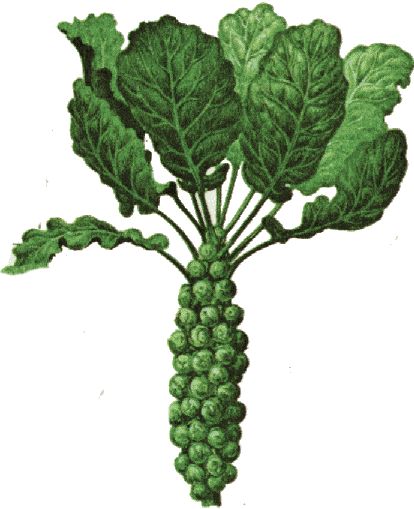
Telegraph.co.uk reports that U.S. Scientists are planning to grow Brussels sprouts on the moon.This experiment will determine whether future space colonies can produce their own food supply – a vital element for any self-sustainable colony. A mini greenhouse dubbed a “Lunar Oasis”- participant in the Google Lunar X Prize - has been developed by Paragon Space Development Corporation in Arizona, and could be on the lunar surface as soon as 2012.
Brussels sprouts, a member of the brassica family, was chosen because of its quick life cycle.The most similar experiments are the successful greenhouses which produce fruits and vegetables near the South Pole.I wonder how Paragon will combat the extreme temperature variation from ‘day’ to ‘night,’ the drastically different periods of light/dark, and other peculiarities plant life has not experienced here on Earth.Without an atmosphere (or scalable substitute) to filter radiation and trap heat the plants do not stand a chance.
NASA has goals of manned missions to the moon by 2020 and manned missions to mars by 2030.If such missions are to occur, their viability rides on the ability to grow food in space and thus tremendously cut the costs of carrying rations into orbit.In addition plants and algae may be used to filter air and create oxygen for breathing.I imagine hydroponics to be one solution because it would reduce the costs of lifting soil into orbit.Many of the essential nutrients can either be found extra-terrestrially or harvested by growing colonies of phytoplankton and zooplankton for that purpose.The process would prove complicated and extremely fragile – illustrating how good we have it here on Earth.
I was looking at some of these awe-inspiring photos of aurorae and pondering the essence of this beautiful natural phenomenon. Even as I was researching on Wikipedia, I Dugg across this article highlighting the development of miniature magnetosphere for protection of space vehicles. These two topics are linked, as this technology works on the same principle as the defense system spaceship earth naturally enlists on our behalf, making life as we know it possible. A miniature magnetosphere can be created using a simple magnet and researchers from the U.K. and Portugal are applying this principle for creating portable extra terrestrial force field to protect space travelers and vehicles alike from radiation. Auroras (northern and southern polar lights) occur in the ionosphere when charged particles traveling along the Earth’s magnetosphere collide with the upper atmosphere. These charge particles emanate from the sun and arrive as solar wind. As the collisions occur, electrons take quantum leaps – thus transferring kinetic energy into visible light.
This spectacular display is a beautiful byproduct of the forces of this world that make our existence possible. The level of solar wind activity can influence the color of the aurorae, but different elements emit different wavelengths:
Red & Green - atomic oxygen Pink & Blue/Violet - molecular nitrogen/nitrogen ions Light Blue & Green - ionic nitrogen Purple - neutral helium Orange (w/ rippled edges) - neon
Tom Morris writes this article for the Huffington Post comparing Plato's Cave to the current financial and economic crisis.
Plato argued that we all live under the distorting influence of illusions.Plato uses the metaphor that we humans are prisoners, chained to a wall in a cave, mesmerized by the shadows we see flickering by – thinking that these shadows are reality.
This metaphor is exemplified by the events that have created and are continuing the economic recession.We are prisoners of the economy - we stare transfixed at the movements of the stock exchanges- thinking them to be the source of ultimate reality.
Tom Morris emphasizes courage and confidence, tempered with just a little caution, as essential to overcoming the fear of the illusory and avoid immobilization.
Here is some fresh work. The squid was created by Mike, and I decided even cephalopods should have to wear a tie to work... You can't tell from these pictures, but the briefcase has an electrical outlet protruding from it. I'll get some more pics of this power peddling cuttlefish up soon
Everything in this universe is chaotic, including life. Even while things seems to be headed in the direction of ultimate organizational maximization, chaotic and seemingly illogical occurrences remind us that, as seen from a existential physicist’s point of view, we are merely a sum of spontaneous and random subatomic particles that straddle the fence between matter and energy. The madness may have some as-of-yet-undiscovered method to it, like the e8 shape, but as of yet scientists have not found logical sequence in the actions of these subatomic particles, things which actually make up everything that we perceive in the material world [though not necessarily everything that is there]- and so the fact that the building blocks make no sense to us shows that life is essentially unpredictable, that the events which happen in the physical world are not teleological.
They have no path or destiny, and what beauty of it! Think of this universe full of individual motion, a cosmic dance of expression, of originality and truth.
Not a pulse but rather a hum, a constant passionate agitation, unsynchronized existence.
Things bumping off and mixing in with other things in a tangled ball of unique togetherness.
An interesting article by Fareed Zakaria titled Free At Lastdeals with the prospect of an energy solution in the future.Raising efficiency is the key; there is no single solution.The revolution that must occur is not technological but “one of attitudes and ideas.”It is estimated that by the year 2050 the human population will exceed 9 billion – and we will need twice as much energy.While it may be true that we need to wean ourselves from our oil addiction, oil will still play a role in the energy mix of the future.Mr. Zakaria argues that instead we will need every available source of energy and “disciplined application of technologies that already exist.”The trick is to be able to find abundant energy at low cost (including the hidden costs to the environment or in the social or military spheres).In addition, we need to limit our waste (and the energy used to dispose of it) by making everything either biodegradable or totally recyclable.
As humans, especially living in industrialized society constantly surrounded and entertained by technology, we forget our connection to the natural world. American pragmatic philosophy offers some insight:
“An organism does not live in an environment; it lives by means of an environment.... The processes of living are enacted by the environment as truly as by the organism; for they are an integration.” ~ John Dewey
Further, how we view our place in the world has many implications for not only our psychological health but also holds the key to forging a sustainable relationship with the environment.
“Nature’s place in man is no less significant than man’s place in nature. Man in nature is man subjected; nature in man, recognized and used, is intelligence and art.” ~ John Dewey
Once we can see this, and really feel comfortably at home on planet Earth, we will realize:
“For what is best in ourselves appears then also outside of ourselves, and we and the universe are of the same spiritual species” ~William James
So we are an integration of the universe with the potential for consciousness and perception of intelligence and art. The Earth IS us. We are the universe. Surely we have responsibility to take care of ourself. We should not be subjected by, warring with, or even trying to outsmart the natural world; instead we must work with it.
I leave you with a related passage from the Bhagavad-Gita:
Know that both nature and man’s spirit have no beginning, that qualities and changes have their origin in nature.
For its agency in producing effect, nature is called a cause; in the experience of joy and suffering, man’s spirit is called a cause.
Man’s spirit is set in nature, experiencing the qualities born of nature; its attachment to the qualities causes births in the wombs of good and evil.
I sit by my computer, for I have blogs that need writing, gazing out my window, open – rhythmic smack of fat rain – which gradually eases through intensity and seems to toggle on/off, pattering on rooftop. Drips fall steadily from far right corner of chimney-top slab, and occasionally from middle or elsewhere. Far side of valley is nearly obscured through opaque mist; but green field shows brightly, mist makes the layers of depth more evident. The clouds are fantastic! Red mug filled with green tea perched in immediate foreground, steaming on sill. Interesting how the water vapor of steam and mist are the same element but with different essences... different causation
Now the rain has cleared and I sit half-lotus on mostly dry roof Birds chirp, warble, chatter, whistle, sing, and call from every direction. A doe grazes through a leaf littered yard. The clouds are more spectacularly defined as the west-side is lit Gold & the east-sides are shades of purple and blue with thin spots showing cream. The main mass moves east-north-east while a lower faster body moves east-south-east. Incense wafts from deep within my room through the open window and makes itself known by floating over my shoulder before it dissolves. I can picture the smoke oozing from the burning cone and forming a long trail that meanders and stretches itself only to flicker from existence at the borders of my perception. eye level with the canopy of 4-story arboretum reveals the first pink and green bus of spring ready to unfurl. As the Sun peaks between clouds, outlining the trees topping western ridge, droplets suspended from branches (bearing only potential leaves, birds, and the afternoon’s water) become thousands of prisms – fluctuating through the spectrum but with a peculiar tendency for gold. A shattered mirror propped up against a neighbor’s garage takes this scene in from 1000 angles, seems to hold the images longer than I can, and reflects the reorganized scenes back... (if only someone was watching...)
The most indigo of skys are coming – this must mean rain tonight.
I sip my tea
Green tea in a red mug
and realize this entire description has played out, reflected from nearly under the surface, of the steamy/misty beverage, shimmering mirror-like literally in front of my nose
I sip (this tea is good)
Now the trees to the east are silhouettes against blue-pink-orange-purple crayola clouded sky. Later, a vague mist will roll in – contrasting the clarity of before. The first few drops will splat with a dull thud as thunder rumbles distantly and the zen rock chimney-top slab begins its drip.
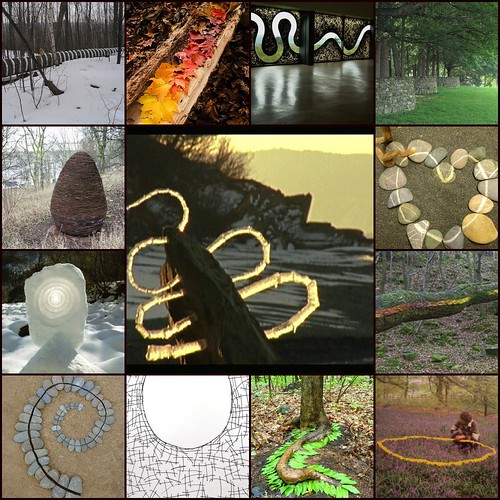
Andy Goldsworthy is a British artist who focuses in natural art.Using materials found in the landscape where he builds his pieces, Andy’s art has astounding natural and organic feel. While some if his work has durability, many of his pieces are not meant to last – as nothing ever does.In “Rivers and Tides: working with time” Goldsworthy explores the ebb and flow of time and liquidity of nature.
“... the film follows the bohemian free spirit Goldsworthy all over the world as he demonstrates and opens up about his unique creative process. From his long-winding rock walls and icicle sculptures to his interlocking leaf chains and multicolored pools of flowers, Goldsworthy’s painstakingly intricate masterpieces are made entirely of materials found in Mother Nature – who threatens and often succeeds in destroying his art, sometimes before it is even finished.”
I am doing a research project on the possibility of Biomass generators and anaerobic digestors scaled to small and medium sized businesses. I have found lots of information about large scale biomass power generation plants, but the fuel for these is often grown specifically for that purpose. I would like to research a more efficient way to transform organic waste directly into energy with minimal environmental impact. Does anyone have any information that might be useful to my search? I would appreciate any help I can get.
A new technology created by Cool Earth Solar uses very inexpensive inflatable plastic balloons that utilize a solar concentrator to focus sunlight onto a photovoltaic cell at the focal point. They claim that they can capture 400 times more energy than the average solar cell with this method. While it is very inexpensive to create the balloon itself, such cheap materials are hardly durable and the cost of maintenance may be high.Some other concerns other bloggers raise include the fact that the balloons are made from plastic and the fact that photovoltaic cells tend to become much less efficient at higher temperatures (400x) and may fail.
I am glad to see technological progress and innovation in the field of renewable and sustainable energy.
The world’s first wave farm, Agucadoura, is up and running off the coast of Portugal and generating power supply enough for 1500 homes. This technology uses the motion of the ocean’s waters to pump pistons and generate renewable energy. I wonder if this can generate energy on a flat day by tidal forces, if so it could be extremely useful in places like the Bay of Fundy, and also to its durability under stormy conditions. I wonder if there is any threat of environmentally damaging impacts such as hydraulic fluid or piston lubricant leaks into the ocean. As we will see, each location on planet earth will have a specific technology that will provide an uniquely advantageous solution to humanity's energy demands.
We shall see how effective this technology is (as I am sure it will go through improvements later down the learning curve) but until then I applaud the innovation and effort to make the world a cleaner and more sustainable place to live.
The word metal usually connotes ideas of hardness, strength, durability, permanence, industry.However, in contrast to its hardness metal is of such great importance to society today and societies of the past (Bronze Age, Iron Age) because of its pliability. Yet, the fluid and seemingly organic properties displayed by the metal in this video may surprise you.This ‘metal’ is actually a ferrofluid, a “colloidal mixture composed of nanoscale ferromagnetic particles suspended in a carrier fluid” and becomes strongly polarized in the presence of a magnetic field. The artists behind this ‘living’ sculpture (Sachiko Kodama & Yasushi Miyajima) use magnetism to influence the crystalline properties the ferrofluid posses. Beyond art, I wonder at future practical applications if such a technology could be used to temporarily bridge gaps in electrical wiring, temporarily shape tools to specific forms, advance Liquid Body Armor (magnetorheological fluid), or create something real from the Terminator T-1000 sci-fi technology.
French animated film La Planete Sauvage (Fantastic Planet, 1973), winner of the Cannes special jury prize 1973, and directed by Rene Laloux was adapted from science fiction author Stefan Wul's Oms en série (1957). This surreal story takes place on the alien Draag homeworld of Ygam where the Draags hold descendants of the earthly human race (Oms) as pets. When these Oms escape captivity they form tribal colonies; which the Draags periodically eradicate they way we do to ants or mice. It is only after the Om called Terr steals a Draag learning device and gains insight to their advanced science that the Oms have a chance to compete for their survival. Upon leaving Ygam and finding the Fantastic Planet the Oms discover they now have the power to disrupt the Draag's mysterious meditation ritual, and use this to force a mutually beneficial treaty between the two races.
I recommend taking the time to experience this film and also note the exceptional score by Alain Goraguer
Here is part 1 of 8 (in english) from YouTube. Be sure to watch all 8
The CHIHULY “The Nature of Glass” exhibit at the Phoenix Desert Botanical Gardens integrates the flora of the Arizona desert with elegant glass sculptures of a fantastically pseudo-organic design. I find an interesting connection in the way both the flora and the glass sculptures are born from the desert sands. The apparent delicateness of the glass serves to contrast with the unique and hearty plants specialized to extremes of their environment. Dale Chihuly, an American glass sculptor and entrepreneur, is the creative force behind this exhibit of surreal botanic art.
The following is quoted from the introduction (by Philip Kapleau) to Thich Nhat Hahn’s Zen Keys with links to relevant articles, mostly from recent headlines.I reorganized the order of the quotes somewhat.
“In the last hundred years this process of constant and explosive change on the social and institutional level has accelerated to a degree unknown to people of earlier ages.Almost daily the newspaper reports new and dizzying crises in the world; famines and natural disasters; wars and revolutions; crises in the environment, in energy and in the political arena; crises in the world of finance and economics; crises in the increasing number of divorces and nervous breakdowns, crises in personal health, in the incidences of heart attacks, cancer, and other fatal diseases, not to mention the number of senseless deaths caused by the traffic in and extensive consumption of illegal drugs.Most people looking out on this ever-changing, seemingly chaotic world see anything but natural karmic laws at work, nor do they perceive the unity and harmony underlying this constant and inevitable change.If anything they are filled with anxiety, with a feeling of powerlessness, and with a sense that life has no meaning.And because they have no concrete insight into the true character of the world or intuitive understanding of it, what else can they do but surrender to a life of material comfort and sensual pleasure?
The contamination of our own and the world’s environment and our squandering of dwindling natural resource through overconsumption, waste, and mismanagement speak eloquently of our greed and irresponsibility.
It is out of this respect for worth of every single object, animate as well as inanimate, that comes the desire to see things used properly, and not to be heedless or wasteful or destructive.
We are deceived by our limited five senses and discriminating intellect (the sixth sense in Buddhism) which conveys to us a picture of a dualistic world of self-and-other, of things separated and isolated, of pain and struggle, birth and extinction, killing and being killed.This picture is untrue because it barely scratches the surface.
There is more to life than what the senses tell them – that in the midst of impermanence there is something always permanent, in the midst of imperfection there is perfection, in chaos there is peace, in noise there is quiet, and finally in death there is life.
For if we could see beyond the ever-changing forms into the underlying reality, we would realize that in essence there is nothing but harmony and unity and stability, and that this perfection in no different from the phenomenal world of incessant change and transformation.
‘In truth I say to you that within this fathom-high body, with its thoughts and perceptions, lies the world and the rising of the world and the ceasing of the world and the Way that leads to the extinction of rising and ceasing.’”






 Posts
Posts


